pondělí 30. července 2012

Some thoughts on objectivity of rating tea

A year or so ago, there was a heated debate on one of local message boards, concerning whether quality and rating of tea* is an objective discipline or not-so-objective one. After a year of thinking, let me sum up my thoughts on the topic in a single place (and, even better, tell me your opinion).
*) Ouch, I realized that I use "tea" and "puerh" almost interchangeably... I mean mostly puerh here.


My proposition is: "Tea can be rated objectively, but there is little point in doing so", i.e., there are some parts of tea evaluation, which are objective, but the interpretation of the measurement and more things that I consider important are sort of subjective.


You can objectively judge the origins of tea - where it comes from, which cultivar it is made of, how large the leaves are, how processed they are, how damaged they are. Of course, the resulting liquor may be measured chemically, but what does it tell us? Lending an example from the world of wine, many Chateauneuf du Pape wines are really densely sweet...yet there is no sugar present (all used in the fermentation process). So if we measure that there is no sugar, what do we know? Well...that there is no sugar. Awesome.


Another objective measures could be creation of histograms of photos of wet leaves, telling us, whether the leaves are aging consistently, etc.


Another possible measure is measurement of the source tree - its age, for exampe. It it really such a good measure? Are todays ancient trees good because they are simply good, or because they are not as massively raped as poor plantation teas? I think it is the latter case (and, as I have been given to understand, it is changing too). I've had several very good plantation teas and some exceptionally boring old trees (or exceptionally unpleasantly bitter wild trees). So, we may, again, measure the source tree, but what does it tell us?


I think that the objective part is awesome for tea merchants and investors - you measure all that and can happily say "my tea is a high quality one", period. They don't have to understand the tea that much, they may concentrate on buying and selling.


To the subjective part - I'll run through the checkpoints I usually observe in tea:

  • Dry leaves appearance and smell - I mostly do not pay that much attention to these. There is a fashion of huge, whole leaves, but I have some doubts whether it is good or not. I feel that a lot of teas from 2003-2007 which were composed of such "beautiful" leaves were heading to the realm of Too subtle and light. I am not saying a tea should be powdered or anything like that, but teas that I consider to be "standard-style" and "aging well", e.g., Haiwan Pa Sha 2006 or Boyou Manlu 2007 are not anything super-awesome, judged by today's standards of the beauty of leaves. 
  • Wet leaves appearance and smell - I enjoy these a lot, especially the aroma. It tells a lot about what is going on in the tea beyond taste. But I don't see what there is to rate.
  • Taste of the liquor - this is a big topic. In wine, there are some "objective" standards, but with all the respect I have towards wine, I think that puerh has more dimensions to it. And the world of french wine is quite orderly too, much more than the world of puerh.
    The issue is that people have different taste buds and will perceive/enjoy tastes differently. Also, a huge factor is the amount of training one has. When I was at my 10th puerh, it was like "hmm, not bad, but these puerh teas are quite similar to each other" - and now, puerh seems like a huge and intricate world to me. I.e., rating taste objectively would be weird because it would be highly dependent on the taster, thus being hardly objective. 
  • Aftertaste - again, people with little experience will not notice it as cleanly as more experienced drinker.
  • Mouthfeel - even more extreme case of the previous point. When I sometimes offer puerh from old trees to non-puerh drinkers, they generally do not notice the strong cooling and tingling sensation at all. Puerh drinkers do. 
  • Cha qi - that is such a subtle and personal topic (yet a crucial one, especially in aged tea) that I would not even try to make an attempt at objective rating.
  • Quality now/in future - what is a "great tea"? Why to invest huge money ($100-200 a cake) into premium 2011-12 teas, when you can get really good mid-aged tea from 2001-3 for that money? These mid-aged teas are already nicely aging, often being at the peak of their taste potential. And, for me, they are ten times more enjoyable than the "potentially awesome" young teas.  So, if we wanted to rate a tea objectively, what would we do with the rating of its potential? The potential for further development is a crucial feature, but it does not make a tea good now.
  • Aging - if you "rate Xiaguan 8653 from 80s", what do you actually rate? Try the two differently stored versions from EoT (if they are restocked) and tell me if you would think it is the originally same tea. 
There are other, general matters - water quality for example. Some teas are good with filtered water, some are better with unfiltered, some are better when in brewed silver, some when brewed in iron. You could go on like that for many lines.

Then, how about the brewing skill? Getting back to the 2006 Haiwan Pa Sha (or 2010 YS Purple tea), these show how important brewing skill is. When brewed "normally", they are okay, but hardly super-awesome. But once one learns how to prepare them, they can get really great. It is a contrast to, e.g., 2009 HLH Yiwuzhengshanor 2008 Menghai Star of Bulang, which is not that sensitive to preparation. 

I think that the most difficult part is the experience of the drinker really... and that the part is such an important one that it makes objective rating quite meaningless. I hear mostly merchants promoting the objective rating - I wonder if there is anything beyond washing hands off unhappy customers.


neděle 29. července 2012

A post of little significance: About a new blog feature and results of little competition


This post is just a short one, it will lead to a longer one which I plan to publish tomorrow.

a) The competition - what is the worst Xizihao I have had? If we were talking about price/quality ratio, the competition would be as tough as it gets - however, I decided to abstract from the price here. Today, I retasted the last competitor and knew he was a winner - the 2010 Laowushan. It is just impossibly impotent. I realized a way how God could create such a tea (Java-style):

class XizihaoLaowushan_2010{
    // properties
   TeaAroma aroma;
   TeaTaste taste;
   TeaAftertaste aftertaste;
   TeaMouthfeel mouthfeel;

//constructor
    public XizihaoLaowushan2010(Path filePath);
   { 
        this.aroma=TeaManager.getAwesomeAroma('Laowushan_2010.xml");
        this.taste=TeaManager.getAwesomeTaste('Laowushan_2010.xml");
        this.aftertaste=TeaManager.getAwesomeAftertaste('Laowushan_2010.xml");
        this.mouthfeel=TeaManager.getAwesomeMouthfeel('Laowushan_2010.xml");
   };
}
}

then the call: was like: 
XizihaoLaowushan2010 xlw=new XizihaoLaowushan2010("2010/Xizihao");

The idea was to read how the tea should taste, smell and all that from respective xml files... but God forgot to add the file path before the name of the xml itself... Sadly, in the year -10000 or so, when he wrote these world's core classes, Java was a mess (just look how it behaved ten years ago...) - and did not tell him about the FileNotFoundException - and as  the files were not found, the getAwesome* methods simply returned null... And that is, dear readers, how the Xizihao Laowushan of 2010 was created.


b) I found the way of "Sorted tea notes" to be less satisfactory than I initially thought. For some strange reason, links to some teas tend to disappear from there. And I thought I'd prefer something more flexible, easier to add, easier to sort and all that. That is why I created a GoogleDoc where the notes may be accessed (and some interesting scatterplots drawn, e.g., vendor X my contentment, etc.). The link is: 
https://docs.google.com/spreadsheet/ccc?key=0AuguYb-CkGEwdHlkN0xnRWZ3UFlDUUoyMDJfd1ROb2c#gid=0

I'd prefer if you, readers, could sort it by any row you desire. Does anyone know if it is possible that you could sort it by any row, but could not change any data? It could be probably done via a bit of scripting and adding a buttton or two, but there are better joys to be had than scripting in GoogleDocs.

It continues the tradition of being subjective, I hope - there are two new columns - VFM - value for me - i.e., how much would I pay for the tea. This is very subjective, for some of these, I'd pay much more than other people and for some, much less. The second column is PQ - price quocient - it is 100* VFM/ how much I really paid. 

The friends who suggested these two columns suggested a third one too, the overall Parker-style rating. There are two reasons why I did not include it.
a) I did not drink enough tea to convert my feelings into a single number in a reasonably widely-used manner. 
b) I do not believe in "objective" labeling of tea. Some people stop reading here thinking "omg, what an idiot" (I know such people). Good for you. The post ends here. I'll try to shed some light on the matter in the next post.


středa 25. července 2012

2012 EoT Baotang

Although one may read it all over the internet (almost), it seems that this year's production of Essence of tea is not that good (I have not had most of their earlier cakes, but I've heard a lot of tell). Is the Baotang going to redeem the previous two cakes?

Redeemer


2012 Baotang


No, these two look different... The problems start when I rinse the leaves - when they open a bit, they are often too oxidized and burnt. More about that later.

The wet leaves give a peculiar aroma - smells to me like 60% flowers, 20% cattle urine, 20% manure/animality. The latter 40% actually makes the tea interesting, I think these aromas are features, not bugs. The smell better than it seems written. However, I'd vouch for 40% manure myself, the 20% urine-ish part distracted me.


The brew is a bit darker than it should I think. In the 2012 Bulang, I did not taste any redness - here, I can taste it quite distinctly at the start of the session; it does not give the floweriness much breathing space.

Further brews bring some smoke, but not really too much (it's better after the tea sat down for a while) and grassiness. And bitterness too. This tea is a very nice one when it comes to bitterness - one may brew it sweet (though boring, in my opinion), as well as more strikingly bitter (well... also not really fun to taste). The good thing is, that when I brew it more bitter, the redness is not nearly as noticeable. I wonder whether the strong bitterness of the 2012 EoT Bulang isn't what helped with the redness of the leaves not manifesting in taste.

All in all, the taste is quite unimpressive. The aftertaste is gentle and allright, coming mostly from the transformation of the aftertaste (as opposed to an aftertaste from the main body of the taste).

Feeling in mouth is not stunning either. After a while, however, some movement on the tongue appears, as the bitterness transforms into aftertaste. It is nice actually.

So far, it has not been too good. However, being as deaf to cha qi as I am, I can feel it strongly here! It feels really good, embalming and kind.

Before summing it all up, let us have a look at leaves:

This is some 6th or so brew - and little burnt pieces are still numerous. There is a lot of such burnt dust there.


The proportion of brown and burnt leaves is lower than in the Bulang (and definitely higher than in the Bangwei).


Nice, green leaves with low level of burning make some 50-70% I'd say.


When I finished the tea session, I felt grotesque - I have not had such a disharmonic, yet harmonizing tea for a long time. The disharmony is a result of not interesting (or maybe slightly unpleasant) taste and the redness, pitted against the very nice energy.

I think that the taste may sit down, calm down, and become an undisturbing part, serving as a small table where good energy may be displayed and appreciated. 

Indeed, this tea is not a redeemer I am afraid. I don't think I'll get to any more of the 2012 EoT's teas, however, I'm looking forward to their 2013 edition. Even though the three teas I have tasted recently were not really that good  (i.e., fitting my tastes/desires), they had something interesting, at least (which I can not say about the Xizihaos, for example).

Further reading: Vacuithé


neděle 22. července 2012

1970 Zhi Ye Loose leaf sheng

Shortly before my last order from EoT, Honza of Chawangshop asked me what I thought of the 1970s loose leaf tea. I had to admit that I did not try it. Why, asked Honza. I realized I had not a faintest idea why. Maybe my slight despect towards loose aged tea? Anyway, I corrected it in my second order from EoT.

The leaves are quite lovely, large and rusty. If Rammstein were to use tea in their performace, this one would fit their theme quite well.


The tea is really pleasant and "welcoming". It is very clean (yes, bedouins could call it wet stored...), nutty and aged. After the 30-40 years of aging, it is well harmonized and ellegant. The harmony is probably what I like the most about the taste. It is not as complex as pressed tea from the 80s (yet somewhat more complex than most teas from 90s I've had), also the main body of the taste is rather short compared to pressed aged tea. The thickness is also a bit lesser than I would fully enjoy. Nevertheless, the tea is not boring, thin or anything like that. I just want to make it clear that it is not really a 1:1 competition for good pressed aged tea. On the other hand, among loose aged tea, it is one of better pieces I think.

It gives an almost surprisingly nice feeling in the mouth which confirms that this is a good tea and it is not priced badly at all. The cooling feeling goes well with delicate, but long lasting aftertaste.


The leaves are very robust and hard, but due to their thickness not really fragile.

Further reading*: Listening to leaves

*) An excellent one.

čtvrtek 19. července 2012

Things are getting better: 2012 EoT Bangwei

Is another cold war upon us? It seems so - except the show-off factor is not travelling to space, nor the creation of the most powerful bomb... it is the creation of the most expensive young puerh! The eastern monoliths of power, Hailanghao and Xizihao clearly dominated the western civilization. Now, a challenger appears - Essence of Tea! Some $145 for a 400g cake from a Jingmai-style tea seems like a fiendish lot of money. As Tea Urchin has kindly pointed out to me, Bangwei is not really that near to Jingmai. However, I feel there is a nontrivial amount of common aspects this tea and Jingmai teas have. It may be due to similar or the same varietal used in these teas I think.


The dry leaves do not smell really special to me (I am notoriously miserable at that though), the wet leaves are better - something like a "dark light fruitiness".


The liquor is slighly more orange that I would expect, but a) there is nothing obviously bad about the leaves, nor the red nastiness in taste - if the tea wishes to be violet, I am not against it, b) the tea was, if I understand the description, harvested in 2011 so it is not really a 2012 tea.

The taste is quite interesting actually. When I used less leaves and longer steepings, I got a very surprising raspberry lemonade taste - I have never met that in a tea. If I brew the tea in the usual way, the raspberries are sort of hidden behind a slightly mutated Jingmai fruitiness (along with the special Jingmai fragrance) and a bit of young grassiness. However, the taste obviously needs to sit down a bit - I think that Jingmai tea often needs to take a rest for a while. For example, the Guan Zi Zai Jingmai from 2011 was not really good and not Jingmai-ish enough when I tasted it young. Yet now, it developed into a more typical Jingmai tea. Yes, the leaves are often too oxidized (and it is actually slightly unpleasant there) and there is a proportion of universal not-much-good leaves - but the tea is quite enjoyable now, definitely better than the boring and not too pleasant thing from half a year ago.

When I returned to young puerh now (I operationally define young as less than a year old), I realized how far I got from drinking this fresh things - many features there annoy and confuse me. For example, this Bangwei - I think it will be very different in a year and I think it will be better (also sprach Jingmai Empirie), but I do not feel I know well enough where it is going to go. That is why I do not buy this fresh tea in quantity anymore - too much of a wild bet to me.

Returning back to how this tea feels/tastes - it is nicely thick; bitter, but not overpoweringly so, furthermore, the bitterness is a rather normal Jingmai bitterness which I find pleasant. And it should fuel the transformation of the tea as it ages - I do not think it will persist and annoy our children.

I think that where this tea really shines is the feeling it gives in the mouth. It is strong, old-tree cooling sensation, a persistent one too! Furthermore, it does not diminish with oncoming brews, therefore it seems that EoT has succeeded in preventing the farmers from adding inferior leaves to the mix. That is, I have been given to understand, a nontrivial feat.

The aftertaste is a gentle, yet distinct and good one, very nicely intermingled with the long-lasting cooling feeling.

I can not really comment on the energy - maybe when the tea sits down. It is strong, but I did not find it to be in a harmony, as I understand it, yet.

The leaves are quite nice and not nearly as damaged as in the Bulang. There are some slightly burnt/overoxidized leaves, but not significantly more than in any handmade tea:


I think that this tea is really promising - not yet excellent in taste, but already excellent in the feeling it gives. The time will determine how this tea actually turns out. There are three hypotheses I have:
a) the tea is overpriced and definitely not worth the money
b) the tea is more expensive than it could (e.g., one could buy cheaper tea, maybe from 2009-11 of similar quality), but it is pretty good.
c) the tea is a great value for the money

I rather reject a) and I am inclined to prefer b) over c). Nevertheless, I'll be waiting for Time itself to prove me wrong - it may happen for sure.

úterý 17. července 2012

2012 EoT Bulang

After hearing so many good things about EoT teas and after having a good experience with their mid aged and aged section, I decided to try their young production too. I often do not enjoy Bulang tea, but the teas I enjoy from there are among the teas which bring me the most enjoyment (along with Yibang I guess, possibly Jingmai). The thing is - all the great Bulangs I've had were pre-2005 - and I have never tasted these when they were young, therefore I do not know the features I should look after in young Bulang.


The dry leaves smell like a rather ordinary dry woody Bulang (which I do not enjoy too much). And they are surprisingly orange:


The wet leaves are way more interesting and characteristic - given the genre, there is a lot of sweetness and a very nice leatheriness/animality. When I brewed the tea using less leaves, trying to make it drinkable, the animality was less obvious.


The liquor is, in my opinion, too orange for a 2012 tea... It smells like an ordinary dry-wood Bulang without smoke - sugary and leathery (some would call it mushroomy  I think).


The good thing about the taste is, that the redness of leaves/liquor does not manifest itself too heavily in taste. The tea starts as sweet and generally pleasant, but with a really brutal Man'E style bitterness. I avoid teas having this kind of bitterness - I found the same bitterness in teas from 80s and 90s, with no signs of it getting transformed and flawing the overall experience. It is very different from, e.g., Jingmai or Banzhang bitterness which tends to transform very well.


The other brews are rather similar to each other - the base of the taste seems to be a very good dry-wood Bulang, but once the heavy bitterness strikes, it wreaks havoc and ruins any possibility of pleasantry.


I believe that the tea would have a reasonable mouthfeel if the bitterness was not so persistent. As it is, I do feel slight tingling on the tongue, but it is fought vigorously by the bitterness. And the bitterness wins.


There are hints of pleasant long-term aftertaste (when the bitterness, at last, vanishes), but nothing otherwordly enough to justify the previous experience.


I tried the tea brewed with my usual amount of leaves, using short steepings - strong, bitter, not that enjoyable; not too many leaves, longer steepings - strong, bitter, even less enjoyable; not too many leaves, shorter steepings - only the bitterness left really.

The tea has its brighter moments - it is occasionally nice. Once the bitter part of leaves gets weak, the mouthfeel is nice (and that is around the 8th brew - not too many teas can keep the cooling/tingling feeling up to there) and there are hints of good taste... but shortly afterwards, the tea loses its steam entirely and vanishes.


Looking at the wet leaves does not do too much justice to the tea - the amount of damaged red leaves is huge (much worse than in TU's Ding Jia Zhai) - and even the green leaves (as the one to the left - that one is the best leaf I could find) have burnt serrations (thanks Hobbes!). One does not expect this in a $110 cake.

I fought the tea valiantly, never been disgusted enough to throw the leaves out - even though bitter, it was drinkable. But I do not think I can enjoy this kind of tea, especially given the huge price. Its biggest deficiency is, for me, lack of anything pleasant. The bitterness which I doubt to vanish anytime soon and the amount of damage to the leaves make the experience only worse... 

neděle 15. července 2012

2011 Tea Urchin Ding Jia Zhai

This is another sample originally from Tea Urchin, yet sent to me by Hobbes. I am very grateful for a sample of this tea as it is one of the three samples which were sentenced to death for being red (sounds like Hobbes is an extremist right-wing dictator now; I do not believe it is the case though). I named a certain feature in tea "redness" too, independently on Half-Dipper. When reading posts by Hobbes, I thought it could be the same thing/taste - but up to now, I could not verify it. Therefore, this sample is an important piece to me as it shows how compatible is our terminology.


The photos show a slightly darker leaves (and twigs, there is a lot of them). Actually, I put recent samples of EoT side by side to this tea to compare the amount of redness. The leaves were very similarly colored, the difference was mostly in the tips/fur. Then I compared it to my "reddish tea benchmark" - 2011 Guan Zi Zai Youle - which was definitely redder (in the aroma too). Therefore, at this stage, I did not believe in the redness of the tea too  much.

I do not smell anything peculiar in the aroma of the dry leaves. The wet leaves raise slight suspicion though - they start really well, being my beloved Yiwu dark fruit, but there is something I have not met in tea of this kind before and which smells a bit out of the place.


The liquor is a bit darker than one might expect, but nothing extra extraordinary in my opinion. And it starts rather yellow, but becomes orange gradually. 

The liquor is thick and a very good mouthfeel starts quite early and is really nice - from the teas I have tried from Tea Urchin up to now (I'll publish the post about Xikong in few days, I consider it here too), this one is certainly the most intense in the way of mouthfeel.

However, certain redness is present :( Hobbes' inquisitorial eye must be really good and sensitive to see the redness in dry leaves - I did not perceive the leaves as abnormal, but the taste is what I understand to be a "too red puerh". 

This being said, the overoxidation (probably) is not as intense to ruin the overally good feeling this tea gives to me. It is thick, sweet and with an above-average old-tree feeling. 

It is not nearly as impotent as other "red" teas I have tried before either. It happily gave me 10 brews and would give a few more. 

Furthermore, from the fourth brew on, I do not perceive the redness in taste - a not really outstanding, but pleasant flowery-fruity taste stays. The taste would not do that well on its own, but as it is nicely backed up by the thickness and sweetness, it feels good.


On the photo above, a randomly chosen sample of leaves has been taken out of the teapot.


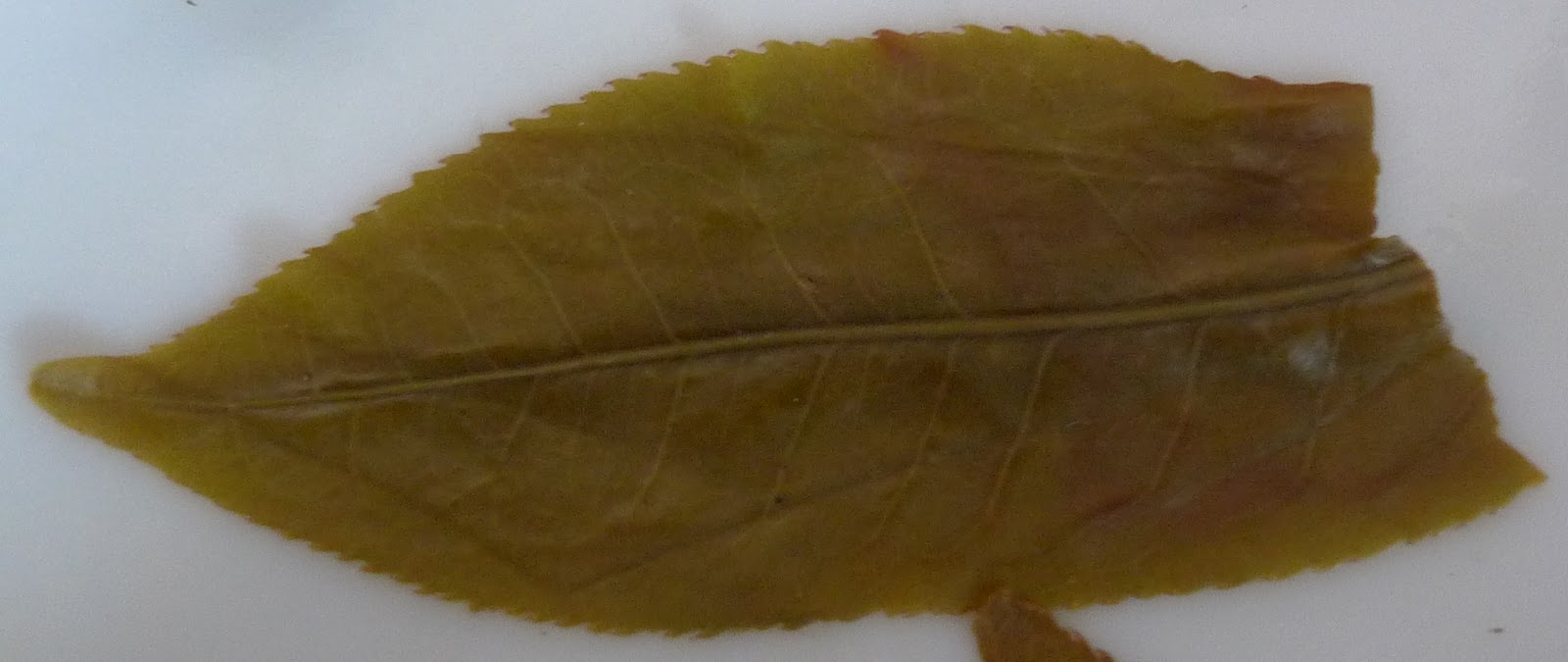
Notice the brown band on the leaf here - a lot of leaves has similar bands/spots.


Overall, I did enjoy the session quite well. Although the redness is definitely a negative for me, it is not that bad and the very good mouthfeel made the session  worthwhile. And, although it may not be the best benchmark, this tea, in my opinion, still strictly dominates all the Xizihaos I have written about, being cheaper on top. However, to balance this possibly overly positive paragraph, I have to say that this is a tea I enjoyed the least from the samples from Tea Urchin.

Further reading: Half Dipper