pátek 11. května 2012

1989 '88 Qing Bing

As the AAMAS conference was "wonderfully" scheduled right into our exam time, I have to study for exams already, which, together with preparing new topics for my students, means less time for tea. However, I wanted to try this tea for some time and wanted to try it before the exams (if I die when attempting to pass the Applications of neural networks, I will at least die as a happy man).


When I bought some gold medalist Mi Lan Dan Cong from Teahabitat three or four years ago, I thought that tea does not get more expensive than that. Actually, it does. Alas, I can not use my favourite self-justifying parallel to the cost of wine, as with the Qing Bing, we are on the level of a rather good wine (at least for me). 


As I had a free afternoon, I decided to go for water from tea stove:


Some  images of dry leaves:


The leaves feel dry, having aged and plummy aroma.


Wet leaves smell beautifully. Their aroma is rich, thick and sweet ("challengingly sweet" I think, although I am afraid it does not make much sense), but very clean and fresh (among aged teas). It is so pure and clean that I feel that smelling the wet leaves cleanses my head. 


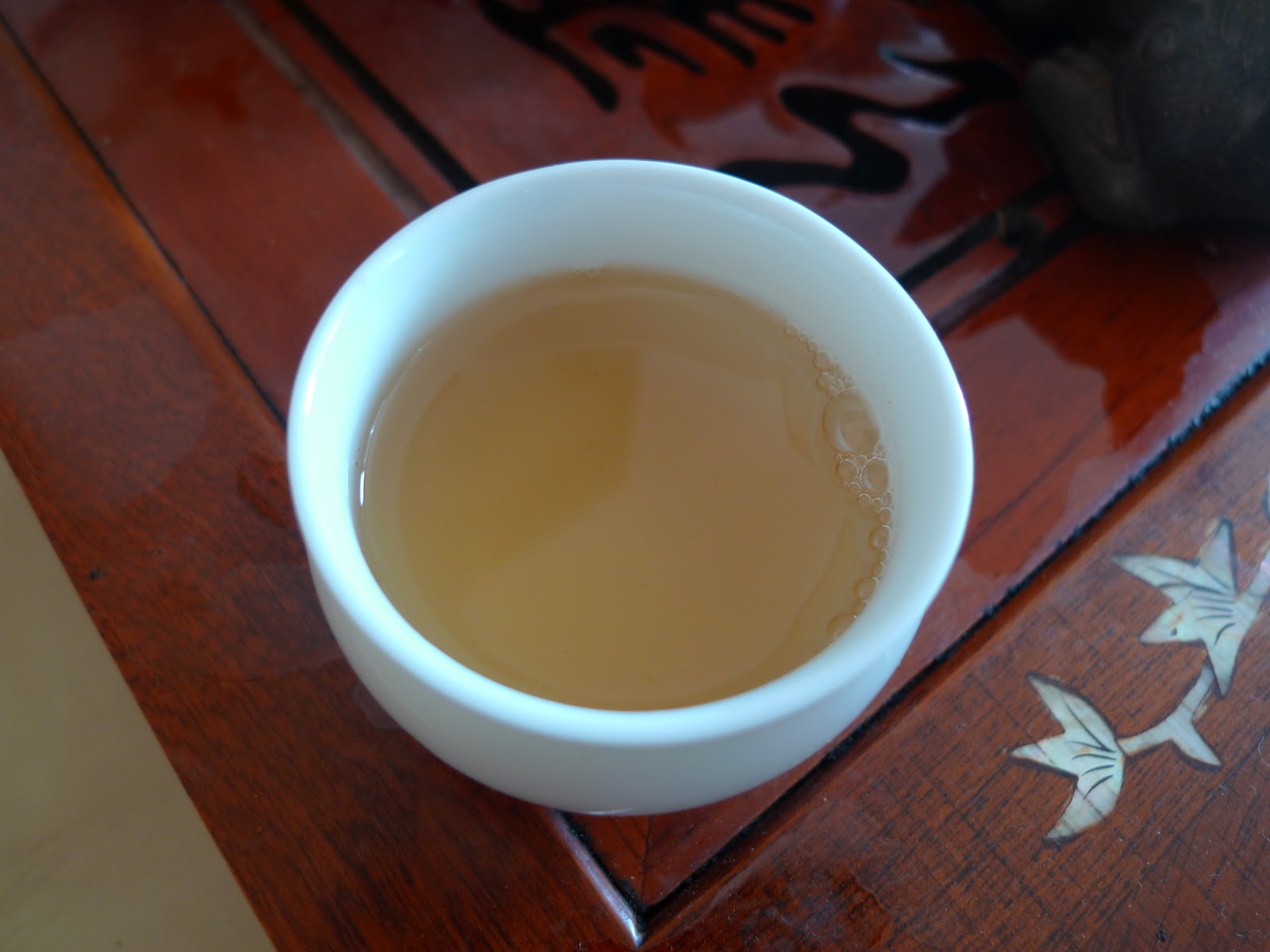
Although taste may not be the most important aspect of aged tea, I found this tea to have an excellent taste actually. It is, similarly to the color of the liquor, exceptionally clean and non-powdery (I do not like powdery feeling in tea too much). Although there is the distinct "aged" taste with wood (a sweet one, like a wood dipped in caramel), there is more - plums, vanilla, some sort of dark fruitiness and when the tea left my mouth, I felt something similar to nice whisky taste. There is a bit of bitter bite to the end of the taste, but nothing unpleasant. Actually, it transforms quite nicely into what I would describe as fresh plums - one is used to older plums/treacle in tea, but I have never met the taste of fresh plums... A most pleasant encounter I have to say! It contributes to overall rather fresh and nice feeling of the tea.


When I swallow the tea, it feels like hundred small spiders run around my mouth, weaving a silky web which stays and fixates the oral cavity for quite some time. The aftertaste (with a bit of fresh plums) stays for a long time.


The tea has beatiful, clean energy. First, it calmed me and then made my chest and head vibrate. It was an excellent opportunity to think and to have a walk through the world as a part of it (it's like when one stands in the wind and then becomes part of the wind - flying with it to unexplored places). I really do not care much if the tea is narcotic or there really is world's energy flowing through everything and I can spot it when drinking some teas, but the feeling is so refreshing and pleasant that I want to experience it again, be it a reality or "behind-reality".


I think it is quite obvious by now that I enjoyed this tea a lot. I did - the tea is clean, rich, feels great in mouth and has a very nice energy. The experience with this tea has cleaned my body and mind and I feel rested as after long sleep. Purrrfect. I liked it even more than the 1980s 8653 Xiaguan (dry stored).


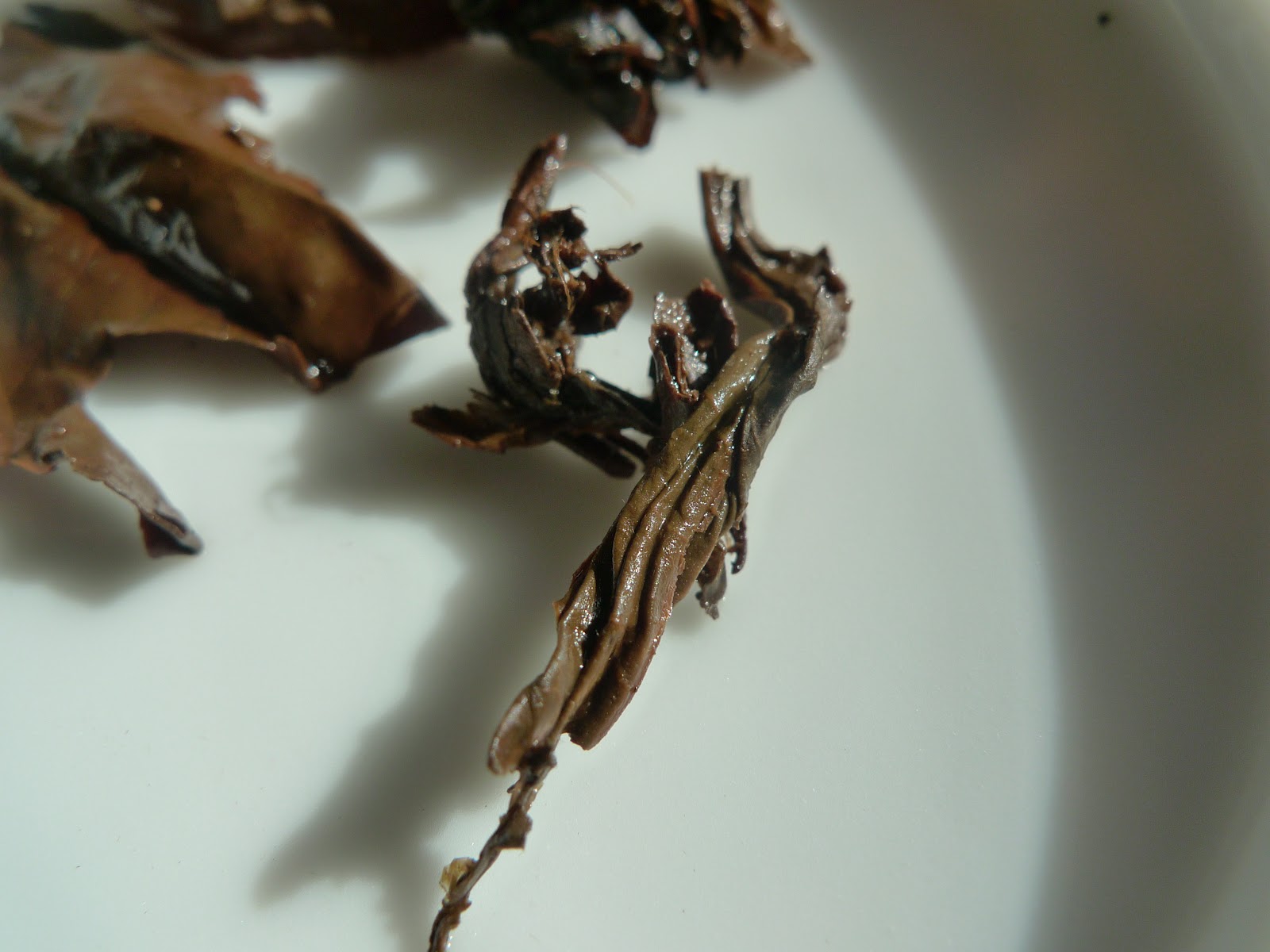
Even the wet leaves are nice (compared to other aged teas I've had), they don't break when rubbed:


Further reading: Cloud
                             Half Dipper

středa 9. května 2012

2007 CNNP Hunan Shouzhu Fuzhuan

Honza of Chawangshop kindly gave me a sample of this tea, but I have been neglecting it for a long time, thinking that anything starting with "2007 CNNP" may not be of any good. Yesterday though, I felt like having a bit of something normal, I saw a sample of this tea and thought I would try it then. Upon opening the package...


It is not nanolemons on the tea, it is really moldy. What is it? A bug? A murderous attempt on my person? An experiment of mad scientist? I pondered these possibilities, but then I remembered reading that some heicha is produced with "golden flowers" fungus (Aspergillius Cristatus). Thinking this might be it, I looked it up on Chawangshop website - in the section of Hunan Heicha. Upon reading more about Hunan heicha, especially Fu bricks, I learned that the golden flowers are not only a feature, but a desirable one too. Some links to sources about Hunan heicha are at the bottom of this page.

Even though it is a "dark tea", I would discourage shu haters from stopping reading here - it is not like shu at all (and much more to my taste). 

Reading that it is a dark tea, similar to dark puerh and seeing the mold, I expected that the tea would be seriously awful. All the more pleasant surprise was the aroma of wet leaves - not wet at all! It was like dried apricots with cinnamon. 


Thinking I was hallucinating, I collected sufficient internal power and tasted the tea... and enjoyed it! The strong tones of dried apricots and cinnamon are still present, complemented by grain (barley), walnuts maybe a bit of dried apples. It is very good. Different from puerh , maybe a bit closer to wulongs in character, but not too close either - a new experience. 

The liquor is rich, thick and feels surprisingly nice in the mouth, being vibrant - it is not as intense as in old tree puerh, on the other hand, it is notably more active than most wulongs. The aftertaste is pleasant. The tea is not as complicated as more complex puerh, but even if being on the simpler side of tea, it is full and good. Its stamina is also good.

I enjoyed the tea in yesterday warm weather, but I feel it would be truly a perfect tea for winter.


The wet leaves are large-ish and not too broken (especially given the low price), bits of fungi still present on them. They break when rubbed, as shu leaves or wet-stored sheng leaves. The price $6.90 per 100g is very low. It reminds us that even puerh used to be cheap, but then the big bubble came and puerh is not that cheap these days. I am afraid that as heicha is growing increasingly popular, it may suffer the same fate in the years to come.

Further reading:


úterý 8. května 2012

2001 Jin Chang Hao Yi Wu

After the excellent 2001 Yi Wu by Yong Pin Hao, let us have a look at 2001 Yi Wu by Jin Chang Hao. Same year, sort of same area, it should be similar. Actually, they are not similar at all, due to different storage. It confirms  that puerh is quite a multidimensional thing - I see five dimensions - area of origin; age; storage; age of trees; cultivation of trees. Preparation is another thing. The high number of dimensions may be confusing at first, but on the other hand, it gives us great complexity - I generally drink only puerh these days and I am never bored. 

My tea setup today, the Yiwu teapot prepared...


The difference between this 2001 Yi Wu and the Yong Pin Hao one is obvious at the moment when one smells and sees the dry leaves. Mild wet storage aroma is present and the leaves are already brown, while the YPH still had hints of green and had no aged aroma.


The aroma of liquor also suggests what I think from looking at and smelling the  leaves - the tea has gone through some wet storage, but not too much/not too wet. Interesting and not too usual hints of cinnamon complement the aged aroma.

I do not really feel any remnants of the Yiwu taste in the tea, but that is usual price one pays for aged tea. The taste is nutty and aged and a bit of plums. Not as deep, sweet and thick as more aged tea, but still pretty nice. It does not have that sourness and unpleasantness of teas that have undergone heavy wet storage. But what I like about Yiwu is the fruitiness or taste of cocoa - these do not appear in this tea really. If you tortured me brutally (young CNNP?), I would maybe say I found some overripe apples in later brews (from 8th brew .or so on), but nothing too intensive. Sadly, the cinnamon is not present in the taste. 

The mouthfeel is not really that strong either, but it, at last, lasts long. The tea overall lasts long, giving many consistent infusions.

The wet leaves are not really that strong, nor firm, when rubbed, they tend to break - again, as one would expect when a tea went through mild wet storage. Heavily wet stored teas break even more easily upon rubbing. 

Where the 2001 Yong Pin Hao was complex, intense and noble, this tea is actually rather simple and only "nice", both tastings I've had came out like that. It does not yet have the energetic/mouthfeel complexities of older teas. 

Where I felt I would pay the high price for 2001 YPH, I feel that this tea is too expensive for me, for what it offers (being slightly cheaper, but much less interesting). From the aged teas I have tried, I thought the 1980s bamboo-wrapped tuocha from EoT to have the best performance/price ratio (and the Xiaguan 8653 to be the best overall - but the 88 Qing Bing will soon challenge it). 

I still have not freed myself from the shackles of taste in tea (and I see little reason in forcing myself to do so). Not that I would not enjoy aged teas where the taste is not that crucial, but I do not feel the need to drink them on daily basis (where I enjoy to drink tea from 2001-2005 daily).

Further reading: Half-Dipper
                            Listening to leaves

neděle 6. května 2012

2001 Yong Pin Hao Yi Wu Zheng Shan

After the rather upsetting (both in mind, taste buds and stomach) experience with the wedding of Bulang, I thought I needed to go back to older tea for a while. I was greatly impressed by a sample of this 2001 Yong Pin Hao and so I decided I would taste it again and write about it. Although this tea is not for sale at Yunnan Sourcing anymore, I thought I would mention it as I enjoyed it so much. It may appear again after all (I hope it does, my purse hopes it does not).
Scott generally does not present his personal opinions on the teas he offers too much and too hard (which is a most commendable approach in my opinion), but in the description of this tea, he said it was really very good. I thought that since I like Yiwu so much, I should definitely try it.


The leaves are actually still greenish, there is no hint of wetness in the aroma, the tea seems to be dry stored.


The aroma of the liquor is correlated with the aroma of dry, as well as wet leaves - dark and sweet, honey-like.

The taste is excellent really. The liquor is thick, tastes of honey and is very sweet. This is what I call extremely rich and complex. It seems that this tea comes from the less fruity and more nutty Yiwu teas. The nuttiness is also aged in a way, giving the taste of walnuts. I really do like walnuts with honey and this tea is just like that. I got tones of "sweet granary" when I prepared the tea tester-style, but using a teapot, the granary taste mingles with the nuttiness and the result tastes like walnuts. There is some bitterness left, but it is not too much of a problem.

The aftertaste is very good, cooling and and vibrant. I feel sort of spoiled, drinking all this tea from older trees.

"The essence of what is good in puerh" says Marketa, my girlfriend, and I do agree. We feel calm and relaxed.

I think, basing my guess on the taste and mouthfeel, that this tea comes from a mix of older and younger trees as it has features of both. The good thing is that there are enough old trees to sustain the very good and long-lasting cooling feeling.

The long-term aftertaste is not too exceptional, but it is present still. It gives a good fruitiness coming from transformation of the bitterness. It feels mid-aged, not being as fresh as in young tea, obviously, but it is still more fresh than overal feeling of this tea.

The tea is dry stored - maybe a tiny bit drier than what would be best, but still, I have less of a problem with slightly too much dry storage than with slightly too muc wet storage (I enjoy both though). This is luckily not the kind of dry storage which sets bitterness to boost and erases deeper aging tones.

It is not really comparable to the 2003 YPH YWZS - the 2003 was also complex and interesting, but it was like several clusters of tastes put together - a bit of this, a bit of that. This tea is more coherent and feels more "together". If I had to compare it to something, it would be the 2001 Yi Wu Bao Pu Xuan, but that one had a wetter storage and is more aged as a result (and less complex in some other ways). Or, it is also somewhat similar to the 2004 Shi Kun Mu Yi Bang.

I thought this tea excellent and enjoyed it very much. It supports my hypothesis that although post-2004 YPH is often not much good, the pre-2004 stuff is generally very good. The price here was $169 a cake, which is a lot, but I would not call the tea overpriced. True, there is the similar and cheaper 2004 Shi Kun Mu Yibang (also not cheap), but this tea is a bit better I think, having even more depth. Another price comparation may be made to the only slightly (10%?) cheaper 2001 Jin Chang Hao of Yiwu, but like the storage of this YPH cake more.

pátek 4. května 2012

2010 Longfeng Dragon of Bu Lang

Prince Far I chants "Let us talk about Jah" in my headphones. Now I chant "Let us talk about the other of the two wedding minicakes". Hmmm, I think that Prince Far I is still somehow more penetrating.

Anyway, I tasted this cake a year and half ago and thought it quite undrinkable (even though I was quite a fan of the vendor and wanted to like all of what he made). The vendor description states that it is ment for long-term aging, so I did not expect it to be great. On the other hand, the taste is supposed to be "extremely strong and distinct, tremendously rich and complex", so I thought I'd give it a try. Now I came back after a year to watch the progress.

Something about the tea: it is supposed to come from trees of "up to 250 years of age". That is not exactly specific as taidi cha with a bit of gushu also comes from trees of up to 250 years of age. Even though the formulation may not be the most fortunate, I am happy to confirm that the leaves are mostly indeed of older trees, the mouthfeel is quite distinct.

The tea reportedly comes from the village of "Zheng Jia San Dui", 15 km from Banzhang (labelled as "close surroundings of Banzhang later in the description"), where the maocha is "basically undistinguishable". First - 15 km from Banzhang? So what? Pasha is 12 km from Banzhang and it is not a "hyped area" really. Bulang is a very diverse area, 15km does not mean that much. Youle is some 20-25 km far from Manzhuan and those areas are quite distinct. Bulang is such a diverse area, taste-wise, that I would not say that 15 km means much. Also, if the maocha of Zheng Jia San Dui is basically undistinguishable from Banzhang, then I'm afraid that this tea is not from Zheng Jia San Dui... it is distinguishable. For example, the bitterness behaves sort of like the average between Banzhang and Man'E. The last thing is, that I could not find the Zheng Jia San Dui on the map... but it may not be there yet or I missed it. The trouble with local vendors is, that they sometimes change the names of their teas slightly so that you can't google the foreign eshop where they bought it - so you never know if the area does not exist, it does exist, but it is small/new, or there is a village called Jie San Dui or something like that...

To the tea itself...


I am used to see a bit more shiny leaves in teas of this age, but the leaves do actually look pretty pretty.

The liquor smells like cigarette smoke which I loathe. The taste was very much like cigarette smoke the year and hallf ago. I do not know if it is a flaw of the material xor a feature xor just that the workers smoked when processing the maocha. I hoped that the cigarette smoke would go away - that's why I tasted this tea again to see.

I can not say that I remember the taste of year ago exactly, but I feel that the smokiness got a bit better. Using only short steepings, I can brew this tea so that it is drinkable (at least for me, my girlfriend says it is too hard and cigarette-like for her). When I do longer steepings, it is again like my shirt when I come back from a concert in a club. The liquor is reasonably strong and in long-term aftertaste, there is a pleasant caramel-like sweetness in some brews.

Is the taste "tremendously complex and rich"? Excuse me, but is the description ment seriously? I hope not... It is reasonably complex and rich; I agree with that (even though I have a hard time enjoying the smokiness).

The bitterness is truly strong, a part of it does transform nicely, a part does not. As I said above, it feels a bit like the average of Man'e and Banzhang. I enjoy the long-term aftertaste, it is a good recompense for the taste.

The positive thing about this tea is the mouthfeel - it is very nice and points to older trees indeed. It does not diminish much with further brews, so it is not the "15% gushu, 85% taidi" mix. The remains of bitterness go well with the cooling mouthfeel.

Were this tea not presented as pompously, I'd say it is all right - even though the taste is only not-too-unpleasant, the mouthfeel and aftertaste do quite make up for it. However, as this tea is presented with the given pomp, I have to say it was a disappointment for me. The wedding set cost about $50 per two 100g minicakes, which is like a $100 400g cake. With both minicakes, I had to try hard to make them enjoyable.

I am not disputing the quality of the material (the leaves are nice, whole, furry, the tea feels good in mouth), nor am I disputing the quality of these teas after the suggested "long term storage". But:
a) I disagree with describing the tea as extremely complex, undistinguishable from Banzhang and all that exorbitant self-presentation. The tea may get good in time, but it is not tasty, nor too complex now.
b) Is there such a bad supply of tea that I will readily pay the equivalent of $100 for a tea which may become good in time? I think not. I can have 2004 gushu Yibang from Shi Kun Mu for some $85 and the tea is infinitely more pleasant (for me, at least) and has similarily high quality mouthfeel. And it is obvious in which direction it ages.

If anyone wants to own a pair of Dragon and Phoenix of Bulang cakes, I will gladly sell an unopened pair at the buying price of 900 CZK or $50.

Addendum - It seems that I got a bad couple of minicakes and several other people have not had cigarette-like pieces. Therefore my issue with the taste is unjustified. I still sort of stand by how funny the description is - even though there is something over it, the tea is hardly tremendously complex and rich. But it probably is good Bulang piece in general.

čtvrtek 3. května 2012

2010 Longfeng Phoenix of Bu Lang

Two years back when I was a big fan of Longfeng, a local tea shop, the owner got married and made two minicakes along that occasion and I bought two sets of these, trusting they would be great. The first minicake I'll write about is the Phoenix, coming from Jie Liang in Bu Lang.

Photos go first again


The leaves do have a sort of strange reddish tint, but the first two photos overemphasized that so I took the other two in direct sunlight. Looking at wet leaves, they have a reasonably green color. Some are a bit reddish, but nothing terrible really.

The taste is described as "very strong, extremely rich and complex, with dominating tone of meadow flowers". The whole description sounds like of Cheng Zhi Tong's literary pupil. Anyway, there is certainly some truth in the description. It is rather strong, reasonably complex and the meadow flowers are truly present (although different from the meadow flowers found in Jinuoshan You Le teas). I do not think this tea to be yet extremely rich though.

I enjoyed the first brew the most - it was rather thick, sweet, flowery and all that. Sadly, from the second brew on, the redness suggested by leaves appeared, along with quite overpowering taste which I'd describe as "soapy". Usually, I'd blame bad storage, but all my other teas age to my contentment and this one is in the same conditions as the rest.

The strange soapy taste is a pity. The tea feels good in mouth, it is active and it has an excellent and long aftertaste and hui gan. Except the main taste, it is very good. Actually, when I brewed the tea using less leaves and longer steepings, the tea did much better - the soapiness is probably not a feature in itself, but too large amount of a certain green taste. 

I don't know, the funny taste may age away... it hopefully will. The tea is declared as ment for longer-term storage (why is it pressed rather lightly and in only 100g cakes then?) so it is not wise to judge too strictly now I guess.

středa 2. května 2012

2003 Xiaguan Jia Ji Export grade

Xiaguan factory produces huge amounts of tea and I can not say that I would be always delighted by their production. I do not enjoy their (since 2004, at least) trademark smokiness and that means that most of their teas are out of the game for me. However, there are occasional pleasant things. The 2001 Jia Ji is rather nice (although priced unreasonably in my opinion) and I do enjoy occasional 2007 Happy tuo (which I believe to become rather famous in future). The 2003 Jia Ji I'm writing about is of even higher quality than these. I would go as far as to suggest that it is a very good tea.

Somewhat dry stored version was sold here by Longfeng, but it is not anymore. What I am drinking right now is the Canton-stored version bought from Chawangshop at a rather reasonable price of $17.90.

The photos first:


The small leaves are tightly compressed and as a result, the aroma of dry leaves is faint. I have a not-so-good habit of using too much leaves of densely compressed teas, thus after obtaining an "appropriate amount of leaves", I put a part of the leaves back to the box.

The aroma of wet leaves is so powerful that it occasionally rides on the edge between pleasant and not-so pleasant. I'm afraid that even given my best effort, I used a bit too much of the tea again. Actually, when I did one longer brew, the not-so-pleasant aspect of aroma was present in the taste - so I suggest keeping the steeping times shorter. Part of the reason may be that the leaves are more broken than what I am used to these days so the taste leaves them faster. This feature of "too much is unpleasant" may sound like a defect, but it is often a signal of good stamina - the Fu Cha Ju 2005 Jingmai was similar in this aspect. Both teas are quite awful when one brews them badly, but they are durable and very good when prepared correctly.

What is this tea like then? Reasonably complex and balanced is what comes to my mind first. It has so many tastes that I actually find it difficult to distinguish between them. Some observations: The tea is nicely sweet. In later brews, honey sweetness appears in the aroma, but less in the actual taste. It starts with a bit of camphor, tones of overripe fruit (and longan) and some spice. Also, slight very pleasant agedness appears. I greatly enjoy teas in this age - still having good things of youth, while obtaining good things of age. All components of the taste go well together, nothing sticks out too much. Some bitterness stays on the tongue for a longer time but it is not too bad. The mouthfeel is good - the cooling is not as intense as in Scott's recent production, for example, but on the other hand, it is quite remarkable considering it is a mid-age Xiaguan tea. And I can feel the tea in the throat for much longer than most other teas. 

It does stay in the pot for much longer than other teas too. The opened leaves fill the pot from 2/3 (not that much for me, actually), now I am drinking some 15-16th brew, doing only 10s steepings and the tea is still dark yellow and intense. 

Even though the tea was stored in Canton, it is in very good shape, definitely does not feel wet or anything. The tight compression maybe helped here. 

I like it. It is all-around a nice and balanced tea and currently in good shape.

Further reading: Half-Dipper