sobota 2. června 2012

Taking tea outside; 2000 Song Zhong

After a very pleasant outside tea session with the remains of 80s bamboo wrapped tuocha (which, again, performed very well), I went outside again today, taking a sample of 2000 Song Zhong Dan Cong with me.


The place of choice today: 


I unpacked all the stuff, lit the charcoal and lied down at the ground... taking a rest for a while, at last. Yesterday (actually, I'm posting this few days later than when I wrote it), I have beaten a rather difficult exam from mathematical structures (no really difficult theorems, but several nontrivial and zillions of small lemmas and properties of various, mostly rather boring, structures), therefore I thought it would be nice to sit down outside with a good tea. Feeling bad, neglecting wulongs lately, I took this 2000 Song Zhong with me.


Thinking about the exam and oncoming AAMAS, the water on the stove got to a more active stage, waking me up.
kettle lid
sings along the wind
rising to the sky


What I really like about drinking tea outside is that I am never alone - all kinds of wonderful small critters provide a welcome company (and, on top of that, my girlfriend and mother accompanied me today too, being wonderful mid-sized critters):


 A grin like Marlon Brando in the Godfather, isn't it?


Are the things in the front eyes on cables? 


I bought today's tea from Longfeng in 2009 (at that time, the cost was about $70 per 50g). I believe that it is the same as the one provided by Canton tea co. here: http://www.cantonteaco.com/loose-leaf-tea/type/oolong-tea/song-zhong-dan-cong-aged-single-bush.html
Funny thing is, that when the tea was sold in the Czech republic, it was presented as coming from "at least 400 years old trees", while the  Canton company, more modestly, states 150-200. Well, that is the ever-persisting curse of resellers and their multiplicative constants. Finely produced tea becomes great, extreme rarity; 200 years old trees become 400 years old and the price is often raised considerably too (however, in the case of this Song Zhong, the increment was not that large - but still, it leaves me wondering of the added value of resellers).


Rants aside, let's get back to the tea:


It smells remarkably nice. I rinse it with the water, reflecting pines above my head:


The wet leaves smell even better - oh my, what an aroma. I would say it is "heavenly fruity" - lychee is dominant, but there is a lot more. And a very strong, yet silky smooth orchid aroma, often found in Dan Cong. This starts good. Not many teas have a "afteraroma" - this tea does have it, thick and honey-sweet.


The taste is really great too - this is how I imagine good Dan Cong to taste. The liquor is sort of light, but the taste is very intense - orchid and lychee. It does not have the annoying bitterness of many lower grade Dan Congs - it is very smooth and very pleasant (there is a bit of bittterness, but nothing annoying). In the overall feeling and taste spectrum, it is rather similar to the 2008 Gold Medalist Mi Lan Dan Cong from Imen (by the way, if your read these lines, Imen, your tea stove has brought me a lot of happiness, thanks!). Nice honey is left in the aftertaste.


This is a really good Dan Cong Tea. However, it is still only a Dan Cong tea - the taste is very good, but I do not perceive much more going on. No tingling mouthfeel, no waves of energy running up my spine. Considering I used the water from tea stove, I find that unfortunate and unexpected. It is like with most Anxi and Taiwan wulongs - tastes good, but does not feel that interesting. From the wulong world, I find Wuyi tea to have the most intense mouthfeel and energy. I wonder why is that.


Therefore, although this tea tastes very good, I do not think I would want to pay this much solely for taste. Good experience nevertheless... For people less acutely responding to energy and feeling bestowed by tea, this tea could be an ideal one.


čtvrtek 31. května 2012

2010 Xi Zi Hao Bulang Xian Zhu

Right ho, the last of post-2008 Xi Zi Hao from the last batch of samples. 

I remove a chunk from a "tea circle" (the tea is pressed into a bamboo tube, thus gaining a circular shape). After the not that good experience with stamina of previous recent XZH, I went for a large chunk  - our weight told us that it is 10g. 10g of Bulang tea is like playing russian roulette with five  of six chambers full. 


The leaves are quite nice, but beautiful Xi Zi Hao leaves leave me cold as a frozen penguin.

The aroma of wet leaves is nice - when the leaves are hot, I'd describe it as woody, fleshy with a bit of flowers. When the leaves cool down, they smell more of fruit and flowers.


The liquor has a reasonable color and clarity.

The taste is quite similar to the 2008 Menghai Peacock of Bulang. This tea is a bit less smoky and more flowery. That is good. However, I feel it is sligthly inferior in the fruitiness - where there was a pleasant fresh fruitiness complementing the main taste in the Peacock, the taste of this Bulang is, at least at the beginning, dominated by sour fruitiness. I do not enjoy such a sour taste that much - it was present in the Peacock too, but in lesser amount. I'd have preferred if this tea was sweeter (I did not notice the sweetness noted on the Houde website - however, the description was, in other ways, matching my own experience). 

By the way, blood is dripping on the carpet, I lost the roulette, removing a portion of leaves in the third brew and reintroducing them back in the 7th brew. 

Beyond the taste itself, the tea is surprisingly thick and smooth (more than the Peacock). There is a pleasant bit of bitterness in the tea (so pleasant after the quite bland previous XZH pieces), transformation of which leads to a fine aftertaste (also sourish, but I don't mind that as much in the aftertaste).

Mouthfeel is rather quiet, I'd prefer more activity in a tea of this level.

I enjoyed this probably more than the two previous weak XZH pieces, despite this being cheaper. I feel this tea still has something to base its future aging on. Even though it was not entirely enjoyable, it is, at least, rather strong. 

Still, at almost $60 per 400g, a tea should be much more than fairly ordinary, "potentially not bad" Bulang. I even can not say that this tea is better than the three times cheaper Peacock of Bulang. This XZH Xiang Zhu is slightly better in some aspects (floweriness, thickness, smoothness, lack of smoke), where the Peacock is slightly better in another (less sour, more intense mouthfeel). Going slightly further than where the Peacock is, the 2007 Boyou Manlu Da Shan costs half of the Xiang Zhu and is, in my opinion, better in any aspect I can imagine.

Further reading: Half-Dipper

úterý 29. května 2012

2009 Xi Zi Hao Jin Xuan

After the barely satisfactory Lao Wu Shan, let us have a look at another recent Xi Zi Hao: The Banzhang/Yiwu brick. I myself often wondered how would the combination of Banzhang and Yiwu taste. I made some experiments, mixing Yiwu with Banzhang and got acceptable, but not really shining tea. 

This brick consists of large, long leaves, it is indeed rather gold:


The aroma of wet leaves heads towards Banzhang woodiness. It is more interesting than that, having something of Krishna-styled shop incense aroma. Deep sweetness is also present. The tea looks promising so far.


In the first brew, the taste is quite gentle, largely Yiwu with bits of Banzhang. Light grain tones are pleasant. Activity of the tea is not too powerful at this stage.

The second brew is still light, flowery, a bit of the incense aroma manifests itself in the taste too. Thickness is good. The activity is more notable than in the first brew, but the tea is still not too impressive overall.

To get something of the tea, I push it hard, keeping it in the pot for half a minute to get the third brew (where I usually steep the tea for 15 seconds). Expecting strong taste, I am surprised by nice, but ultimately light and distant fruitiness. The activity gets better, but not what I would not see earlier. Pleasant tannins finish the taste, quite enjoyable. When I give up waiting for hui gan, it comes at last. Long-term aftertaste is good, Banzhang-powered sweetness. 

The fourth brew (40s!) brings a more interesting taste of peaches, but after a short while, it withdraws back to Banzhang woodiness and then to nothing. The activity becomes weaker and it is even weaker in oncoming brews. The tea needs longer and longer steepings which could be expected in autumnal plantation tea, but most certainly not in a tea of this caliber.


I do not feel any significant energy in this tea.

I am afraid, as in the case of Lao Wu Shan by the same producer, that if this tea was priced around $40; $50 at most, it might be considered worthwile. For the asked $145, it feels like a not that good joke I'm afraid. Taste-wise, there are more interesting teas for $25. Feeling-wise, there are similarly interesting teas below $50 (with energy that fits me better), which, on top, taste more interesting and last longer. 

It supports my previous thought that recent XZH tea is 2-3 times more expensive than it should. "For puerh lovers, it is not necessary to add anything more" - haha. It really is like with luxurious boutique leather handbags which women use to demonstrate how rich they (or their husbands) are, more than making good use of the actual quality (which is, as with these XZH teas, undeniably above-average, but hardly worth the price). I can imagine that if one is used to weaker plantation tea and then gets this, he may be convinced into thinking that this is a super uber powerhouse. If one tried some other old tree material, this tea seems rather clearly inferior (except the price, of course :)). I hope that the 2007 XZH samples will perform better.

I wonder where is the problem with these teas. Are the big leaves a problem? Is there an issue with Houston storage? I don't know...

sobota 26. května 2012

2010 Xi Zi Hao Lao Wu Shan

Although I have tried some Xizihao samples in the past, there was no system, they were far away from one another. Therefore I decided to try more of them - and that is why I bought samples from Hou De.

Upon opening the package with this tea, I thought "wow, this smells quite interesting". Then I opened another package and thought "gee, this smells almost the same, how come?" When the third tea smelled the same (and the rest too), I realized it's not the tea but the packaging. I remember people saying that it is difficult to find bags which don't have any smell of their own. 

The good thing is that the  tea itself is probably not damaged by the smell of the package (this Lao Wu Shan is not, at least).


I think the leaves are quite nice, being large, unbroken and furry.

The wet leaves give a good aroma, although hardly spectacular. I'd say it is a sort of very good universal sheng (US) - there is a base of US and promising aroma lingers above it.  Nice meadow honey is present in the "aftersmell". 

Will this Lao Wu Shan challenge and beat my current US-champion, the 2004 Shi Kun Mu? Challenge, probably. Beat? Let's see.


The liquor is nice, with a rather light aroma of mushrooms and flowers.

The taste starts quite light, becoming a bit denser in forthcoming brews. The taste is largely a universal sheng/Jinggu (the intersection of these two is highly nontrivial I think) too, but as in the aroma, some bad things about US are not present and some good things which usually are not in US are present here. The taste starts with a bias towards fruitiness, nice, light one (blueberries?). Then a rather powerful bitterness comes...and when it fades away, there is not hing for a while. Then the feeling of old trees comes, nice and proper...and then not much more  again. I found the lack of longer taste and more notable aftertaste a bit disappointing.

The tea is fairly consistent across brews, the bitterness becomes stronger and stronger, sadly. I hoped that it would become more interesting, that there would be something which would captivate me. My hopes were in vain. Actually, the tea does not last that long either, it runs out of steam around 7th brew - producing nicely yellow, yet tasteless water up to some 11th brew.

Thickness of the liquor is substandard among gushu teas I've tasted so far.

The wet leaves are nice, in good shape, without much processing faults (burned edges and all that).


Were this my first gushu, I'd be probably blown away by the mouthfeel. As it is not, I am not really impressed. For example, the 2004 Shi Kun Mu Menghai (who retains the title of US-champion) is cheaper and better (and six years older, meaning one knows better where it is heading). Staying in Jinggu, the 2003 Jinggu Bai Long Te Ji, though possibly not from as fancy material, has the advantage of 7 more years of age which gives it an edge over this XZH tea. The less-than-half price sharpens the edge considerably. 

I am not really sure that Jinggu is capable of producing tea worth the asked $95 per cake (unless it is at least 1kg cake). When one connects the current quality of this tea with the statement of MarshalN that Jinggu teas don't age too well (and I have no reason not to believe him, given his knowledge), I see no reason in asking so much money for this cake. 

This tea is most certainly not bad - it is rather good on the absolute scale. But I am afraid I am not willing to pay more than $40 for a "rather good" tea. Especially for a tea which balances between "gentle" and "weak".

By the way, I'd be interested in a comparative tasting to the 2011 version which hangs around in the Czech Republic - if you're from Prague (or willing to pay the post), I'll gladly give/send you a bit of this so you can compare it (and write about it). Of course, if you give me a sample of the 2011 version in exchange, I will be delighted, but it is certainly not necessary.

Further reading: Half Dipper

čtvrtek 24. května 2012

2010 YS Bang Ma

Four boxes of tea are on their way as I am running out of samples. Recent excavations of my tea drawers (no snakes in there) have yielded a small bag with a sample of Scott's Bang Ma.

Spring brings us fresh leaves and this tea feels  fresh too:


The dry leaves smell like usual light-fruity Mengku (this sort of tea often reminds me me of Burgundy wine, often with the same unpleasant stomach-feel). Not expecting much, I rinsed the leaves.

The liquor smells only very faintly, after mushrooms. Not that pleasant.


Contrary to other bloggers, I found the taste to be actually rather bitter (maybe i used more leaves), not as harmonic and rich as the aroma. The fruitiness starts a bit thin, but from the 3rd brew, it gets more and more like blackberries - I enjoy these brews very much! A bit of grain complements the fruit nicely. I enjoyed that this tea was, unlike some fruity Mengku, rather full (not as much as Yi Wu, but still good). The aftertaste is  quite rough, heavy on tannins (I like Matt's "chalky"). I found occasional rare hints of tobacco. Hints of honey appear in later brews. However, the peak of this tea is not that long, it gave me two or three wonderful brews, five or so nice brews and the rest was only "allright".

The mouthfeel after swallowing the tea is reasonable, pleasantly cooling. Marketa who is probably learning to become a grandmaster of empty cup aroma appreciation notes (and she is right) that the aroma of empty cup is quite intense and good. It is. I like these high bone porcelain cups as they are sort of hybrid between a cup and a wengxiangbei.

The leaves are large and muscular*, largely intact:
* "The british leaf is on the march" jumps to my mind, in a Spode-ish voice.


This tea is not really heavy on noblesse and smoothness, but it at least it is interesting. If the darker tastes stay there and get even deeper and more pronounced, this may be a real treat in future. I am actually tempted to buy more of this tea. Scott asks the paltry sum of $27 for a bing - a very nice price in my opinion.

There is one thing about Scott's cakes. At least in the short term (we have to wait for the long term), they get better. There are several of his pieces which I found not that lovely when too fresh - this tea felt distinctly hollower, for example; more stomach upsetting. Now, after a year, most of these problems are gone and Scott's teas have brought me many pleasant tea sessions. 

Further reading:


úterý 22. května 2012

1992 Xiaguan Raw(?) tuocha

I find this tea quite puzzling. It is difficult to tell what it actually is. I'll just tell how I got it, why and how the tasting went. I'll be glad for your opinions on this tea. 


Some people around spoke highly about '84 and '92 Xiaguan tuochas. These are not available from any vendor I usually buy from, but I found that the Canton tea company has exactly these two vintages. They did not have any samples of the '84, but they had the '92 and so I bought it.


Dry leaves first:


The first surprise - the leaves smell like teen shupu! Being afraid I've been ripped off, I cautiously steeped the tea...


The taste of the first two brews was quite shu too. I brewed Scott's Bu Lang Hui Run along (one of the best shu puerhs I've met by the way - I really like the way how Scott makes his shu - be it the cha tou or this bulang cake) to compare - similar indeed. The color of the liquor was a bit too light for shu, but then again, I don't know shu all that well.

From the second brew on, the caramel/cocoa shu taste stayed only at the beginning of the taste and gradually got shorter and shorter - being replaced by mid-aged taste of sour-ish overripe fruit and meadow flowers. The aftertaste of 2nd and 3rd brew was nice, aiming towards berries and plums. A bit of remaining sheng bitterness further suggests that this tea is not really a shu. At this stage, I seriously considered that this could be a blend of shu and sheng as the two parts of the taste (shu start and sheng end) were not really in harmony and together.

The activity of this tea on the tongue was fine in the 2nd and 3rd brew - not too strong, but long, at last.

Between the 3rd and 4th brew, the tea came to a break - the wet leaves ceased to smell shu/aged - only like a generic but allright mid-aged sheng.

The taste...not good since 4th brew on. It is not bad, not at all - it is ok. But it lasts only about a second and half. Then, a complete emptiness appears and steals all the taste. This is maybe a tea to help with "become full of emptiness" meditation. Other than that, it has no merits I am afraid. The mouthfeel is insignificant, I don't feel any deeper energy either. Like the tea was stale and bored of life.

The tea's wish to die soon is supported by its lack of stamina (honestly, I pushed it towards the terminal 7th brew only to see how far it goes, I can not speak of much enjoyment).

What is puzzling me is, that this tea is not a shu puerh - it starts as one, but it is not. But it can not be only a wet aging sheng (if so, it is very strangely aging) as it feels distinctly dry-stored green after the shu taste goes away. I think that this kind of dry storage is what most dry storage haters fight and I can see why. I've had only several very dry stored teas and they all had these sour overripe fruit tones and strange kind of bitterness as this one, bringing discomfort to body.


I was looking forward to the inspection of the leaves, expecting there would be some leaves black and some leaves green (supporting my shu/dry stored sheng mix hypothesis). Let's have a look and speak after that:

How the leaves looked after being taken out of the pot:


 There are obviously two kinds of leaves - one is rather green, the other is rather dark brown (the brown being probably more common in the mix):


The first (left) one after being rubbed:


The right one after being rubbed:


Not only there are different grades of leaves, but the quality of the leaves is quite different. It is like a part was dry stored sheng and the other part was wet stored or even shu (I think that the taste was really more like shu rather than wet sheng so I'd probably say that it is rather a lightly fermented shu, not being entirely black).

And one more thing:

I found these small black-ish things among the tea leaves. I can not say for sure, but I think it might be a shu powder - it would explain the shu taste which pretty much wore away from the taste since  the 3rd brew on, as well as why I havent found any typical shu leaves.

So, my uneducated guess would be a mixture of green, dry stored leaves, some wet stored or lightly fermented shu leaves and a bit of shu powder to give it more aged feeling.

It was an interesting experiment to drink this strange hybrid, but I can not say I'd find it  too enjoyable. Certainly not for the $1 per gram. I can not see how anyone could think highly of this tea - it's either a fake, or the person who sold it to local people is a 80th level hypnotizer. 

This tea could be probably saved from complete misery if moved to a wetter storage, but I doubt it would become much good anyway...


neděle 20. května 2012

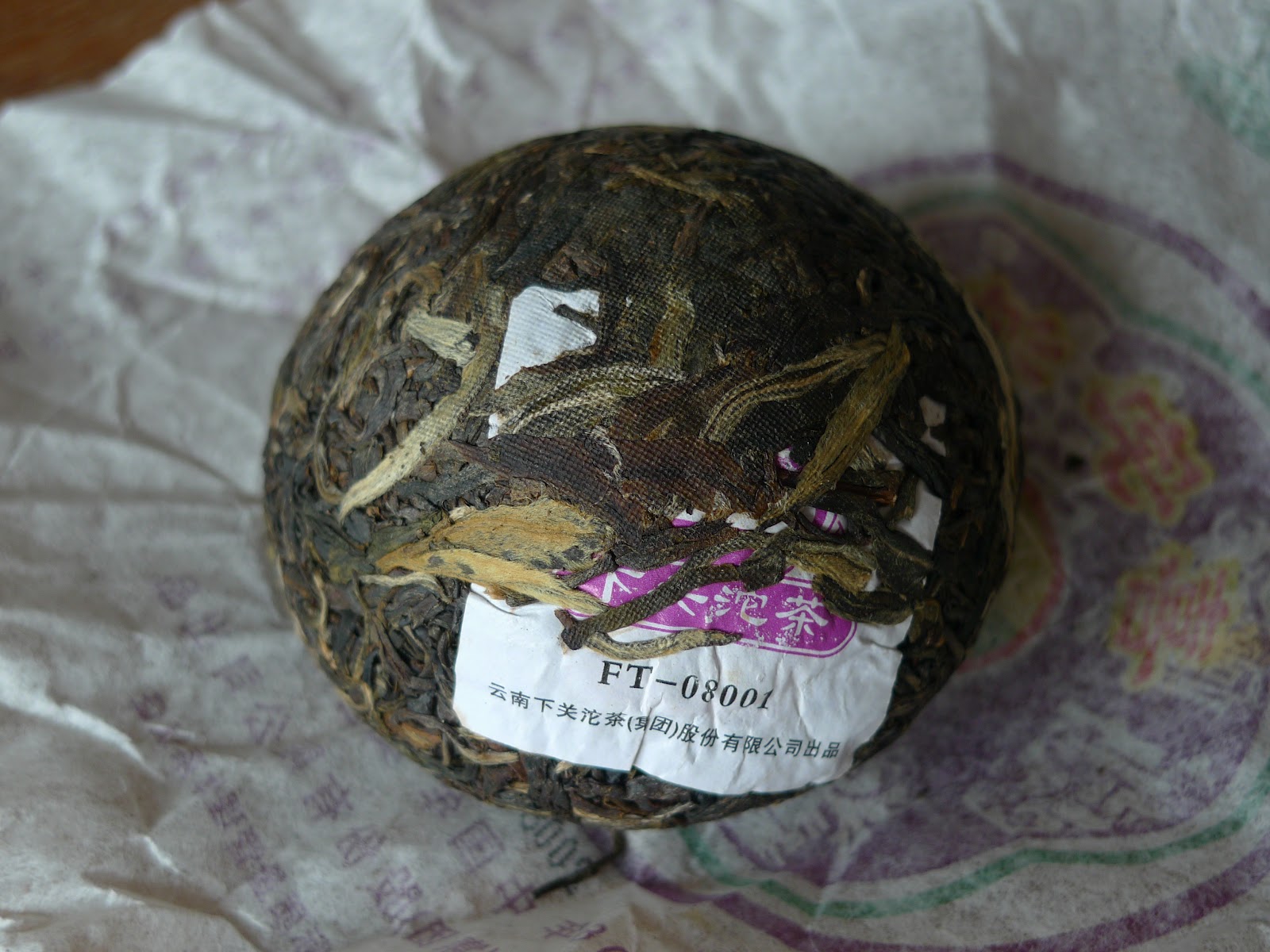
2008 Xiaguan "Xizi" Tuo (Happy Tuo)

Even though many a word has been written about this little tuocha, I have been introduced to it a recently, a year ago, not knowing anything about its fame. A friend who likes Xiaguan (I do not in general) has given me mostly samples of XY brand (most of them were fine, but not much to my taste) and then there was the FT Happy tuo. It stood out between the dark-tobacco smoky stuff as different and pleasant. I was struck by its similarity to Xiaguan 2003 Jia Ji - I felt the Happy tuo to be closer to the 2003 Jia Ji than pre/post 2003 Jia Ji. Strange, I agree. It is also bears a degree of similarity to the mysterious (and extremely concentrated) 2008 Mengku of Chanteas.

Trying the Happy tuo recently, I felt it is going in the right direction and bought a bunch of them.  Although I respect the 2003 Jia Ji and therefore this tuo too, it is not really the kind of tea I'd have to drink on weekly basis. 

As I have tasted the 2009 Gold Ribbon few days ago, I thought I'd try another Xiaguan for a comparison. Photos first (colors are not perfect, it is actually more pinkish):


The medium amount of compression suggests that this is indeed not a common Xiaguan production.The leaves are still slightly smoky, but less than the year ago - that is why I decided to buy more of these tuos actually. The aroma is nice, gently smoky and longan-like (similar to what is commonly described as "candy", I think).

The aroma of wet leaves says "gee, I am really similar to the 2003 Jia Ji".


The taste is somewhat less similar, but the longan is still there. The taste is quite fine, rich, mellow, woody, balanced, with just a bit of smokiness (not the hard Xiaguan tobacco, rather like a gently smoked wood or a smoked cheese) and sweet tobacco. This is one of few smoky tastes that I do enjoy. Hints of overripe fruit appear, I hope (and believe) that they will become more pronounced in time. Sweetness is good, the aftertaste is nothing to write home about, but it is not disturbing at least. Overall, the features of taste point somewhere to Lincang, Mengku?

The mouthfeel of the first brew was rather weak and I was afraid that this would be another "tastes good, feels bland" factory tea, but further brews have proven me wrong - the mouthfeel actually develops very nicely and is surprisingly strong. The tea had a good degree of energy to it.

Many teas last longer - longevity is not a shining merit of this tea. It is not bad, to be sure, it is just lasts a bit shorter than the "premimum" production I've been drinking lately. 

Overall, I think that as long as your expectations stay on the ground, this tuo will indeed make you happy. It currently costs $5.50 at YS (the same as Gold Ribbon when it was in stock - the Happy tuo is much more to my taste though). A good, pleasant drink with a hopefully good future.

Further reading: