neděle 22. července 2012

1970 Zhi Ye Loose leaf sheng

Shortly before my last order from EoT, Honza of Chawangshop asked me what I thought of the 1970s loose leaf tea. I had to admit that I did not try it. Why, asked Honza. I realized I had not a faintest idea why. Maybe my slight despect towards loose aged tea? Anyway, I corrected it in my second order from EoT.

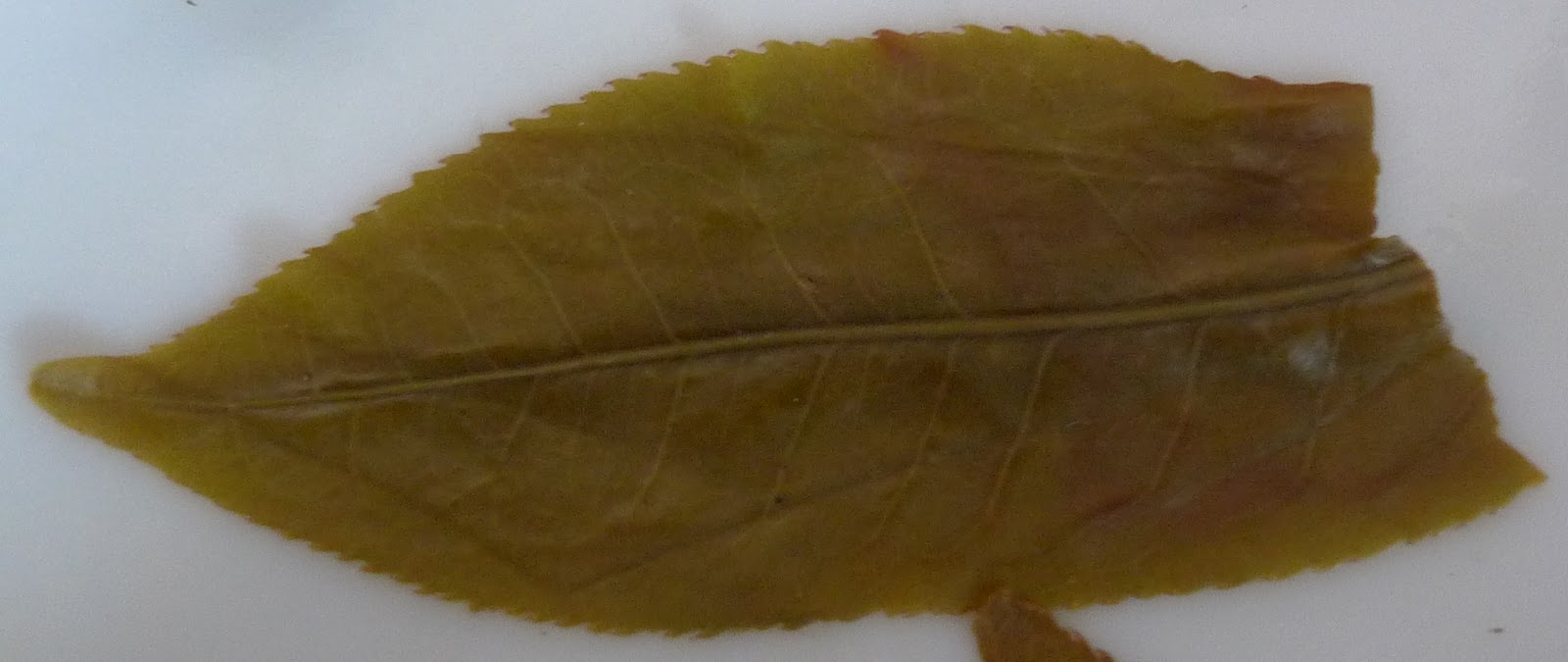
The leaves are quite lovely, large and rusty. If Rammstein were to use tea in their performace, this one would fit their theme quite well.


The tea is really pleasant and "welcoming". It is very clean (yes, bedouins could call it wet stored...), nutty and aged. After the 30-40 years of aging, it is well harmonized and ellegant. The harmony is probably what I like the most about the taste. It is not as complex as pressed tea from the 80s (yet somewhat more complex than most teas from 90s I've had), also the main body of the taste is rather short compared to pressed aged tea. The thickness is also a bit lesser than I would fully enjoy. Nevertheless, the tea is not boring, thin or anything like that. I just want to make it clear that it is not really a 1:1 competition for good pressed aged tea. On the other hand, among loose aged tea, it is one of better pieces I think.

It gives an almost surprisingly nice feeling in the mouth which confirms that this is a good tea and it is not priced badly at all. The cooling feeling goes well with delicate, but long lasting aftertaste.


The leaves are very robust and hard, but due to their thickness not really fragile.

Further reading*: Listening to leaves

*) An excellent one.

čtvrtek 19. července 2012

Things are getting better: 2012 EoT Bangwei

Is another cold war upon us? It seems so - except the show-off factor is not travelling to space, nor the creation of the most powerful bomb... it is the creation of the most expensive young puerh! The eastern monoliths of power, Hailanghao and Xizihao clearly dominated the western civilization. Now, a challenger appears - Essence of Tea! Some $145 for a 400g cake from a Jingmai-style tea seems like a fiendish lot of money. As Tea Urchin has kindly pointed out to me, Bangwei is not really that near to Jingmai. However, I feel there is a nontrivial amount of common aspects this tea and Jingmai teas have. It may be due to similar or the same varietal used in these teas I think.


The dry leaves do not smell really special to me (I am notoriously miserable at that though), the wet leaves are better - something like a "dark light fruitiness".


The liquor is slighly more orange that I would expect, but a) there is nothing obviously bad about the leaves, nor the red nastiness in taste - if the tea wishes to be violet, I am not against it, b) the tea was, if I understand the description, harvested in 2011 so it is not really a 2012 tea.

The taste is quite interesting actually. When I used less leaves and longer steepings, I got a very surprising raspberry lemonade taste - I have never met that in a tea. If I brew the tea in the usual way, the raspberries are sort of hidden behind a slightly mutated Jingmai fruitiness (along with the special Jingmai fragrance) and a bit of young grassiness. However, the taste obviously needs to sit down a bit - I think that Jingmai tea often needs to take a rest for a while. For example, the Guan Zi Zai Jingmai from 2011 was not really good and not Jingmai-ish enough when I tasted it young. Yet now, it developed into a more typical Jingmai tea. Yes, the leaves are often too oxidized (and it is actually slightly unpleasant there) and there is a proportion of universal not-much-good leaves - but the tea is quite enjoyable now, definitely better than the boring and not too pleasant thing from half a year ago.

When I returned to young puerh now (I operationally define young as less than a year old), I realized how far I got from drinking this fresh things - many features there annoy and confuse me. For example, this Bangwei - I think it will be very different in a year and I think it will be better (also sprach Jingmai Empirie), but I do not feel I know well enough where it is going to go. That is why I do not buy this fresh tea in quantity anymore - too much of a wild bet to me.

Returning back to how this tea feels/tastes - it is nicely thick; bitter, but not overpoweringly so, furthermore, the bitterness is a rather normal Jingmai bitterness which I find pleasant. And it should fuel the transformation of the tea as it ages - I do not think it will persist and annoy our children.

I think that where this tea really shines is the feeling it gives in the mouth. It is strong, old-tree cooling sensation, a persistent one too! Furthermore, it does not diminish with oncoming brews, therefore it seems that EoT has succeeded in preventing the farmers from adding inferior leaves to the mix. That is, I have been given to understand, a nontrivial feat.

The aftertaste is a gentle, yet distinct and good one, very nicely intermingled with the long-lasting cooling feeling.

I can not really comment on the energy - maybe when the tea sits down. It is strong, but I did not find it to be in a harmony, as I understand it, yet.

The leaves are quite nice and not nearly as damaged as in the Bulang. There are some slightly burnt/overoxidized leaves, but not significantly more than in any handmade tea:


I think that this tea is really promising - not yet excellent in taste, but already excellent in the feeling it gives. The time will determine how this tea actually turns out. There are three hypotheses I have:
a) the tea is overpriced and definitely not worth the money
b) the tea is more expensive than it could (e.g., one could buy cheaper tea, maybe from 2009-11 of similar quality), but it is pretty good.
c) the tea is a great value for the money

I rather reject a) and I am inclined to prefer b) over c). Nevertheless, I'll be waiting for Time itself to prove me wrong - it may happen for sure.

úterý 17. července 2012

2012 EoT Bulang

After hearing so many good things about EoT teas and after having a good experience with their mid aged and aged section, I decided to try their young production too. I often do not enjoy Bulang tea, but the teas I enjoy from there are among the teas which bring me the most enjoyment (along with Yibang I guess, possibly Jingmai). The thing is - all the great Bulangs I've had were pre-2005 - and I have never tasted these when they were young, therefore I do not know the features I should look after in young Bulang.


The dry leaves smell like a rather ordinary dry woody Bulang (which I do not enjoy too much). And they are surprisingly orange:


The wet leaves are way more interesting and characteristic - given the genre, there is a lot of sweetness and a very nice leatheriness/animality. When I brewed the tea using less leaves, trying to make it drinkable, the animality was less obvious.


The liquor is, in my opinion, too orange for a 2012 tea... It smells like an ordinary dry-wood Bulang without smoke - sugary and leathery (some would call it mushroomy  I think).


The good thing about the taste is, that the redness of leaves/liquor does not manifest itself too heavily in taste. The tea starts as sweet and generally pleasant, but with a really brutal Man'E style bitterness. I avoid teas having this kind of bitterness - I found the same bitterness in teas from 80s and 90s, with no signs of it getting transformed and flawing the overall experience. It is very different from, e.g., Jingmai or Banzhang bitterness which tends to transform very well.


The other brews are rather similar to each other - the base of the taste seems to be a very good dry-wood Bulang, but once the heavy bitterness strikes, it wreaks havoc and ruins any possibility of pleasantry.


I believe that the tea would have a reasonable mouthfeel if the bitterness was not so persistent. As it is, I do feel slight tingling on the tongue, but it is fought vigorously by the bitterness. And the bitterness wins.


There are hints of pleasant long-term aftertaste (when the bitterness, at last, vanishes), but nothing otherwordly enough to justify the previous experience.


I tried the tea brewed with my usual amount of leaves, using short steepings - strong, bitter, not that enjoyable; not too many leaves, longer steepings - strong, bitter, even less enjoyable; not too many leaves, shorter steepings - only the bitterness left really.

The tea has its brighter moments - it is occasionally nice. Once the bitter part of leaves gets weak, the mouthfeel is nice (and that is around the 8th brew - not too many teas can keep the cooling/tingling feeling up to there) and there are hints of good taste... but shortly afterwards, the tea loses its steam entirely and vanishes.


Looking at the wet leaves does not do too much justice to the tea - the amount of damaged red leaves is huge (much worse than in TU's Ding Jia Zhai) - and even the green leaves (as the one to the left - that one is the best leaf I could find) have burnt serrations (thanks Hobbes!). One does not expect this in a $110 cake.

I fought the tea valiantly, never been disgusted enough to throw the leaves out - even though bitter, it was drinkable. But I do not think I can enjoy this kind of tea, especially given the huge price. Its biggest deficiency is, for me, lack of anything pleasant. The bitterness which I doubt to vanish anytime soon and the amount of damage to the leaves make the experience only worse... 

neděle 15. července 2012

2011 Tea Urchin Ding Jia Zhai

This is another sample originally from Tea Urchin, yet sent to me by Hobbes. I am very grateful for a sample of this tea as it is one of the three samples which were sentenced to death for being red (sounds like Hobbes is an extremist right-wing dictator now; I do not believe it is the case though). I named a certain feature in tea "redness" too, independently on Half-Dipper. When reading posts by Hobbes, I thought it could be the same thing/taste - but up to now, I could not verify it. Therefore, this sample is an important piece to me as it shows how compatible is our terminology.


The photos show a slightly darker leaves (and twigs, there is a lot of them). Actually, I put recent samples of EoT side by side to this tea to compare the amount of redness. The leaves were very similarly colored, the difference was mostly in the tips/fur. Then I compared it to my "reddish tea benchmark" - 2011 Guan Zi Zai Youle - which was definitely redder (in the aroma too). Therefore, at this stage, I did not believe in the redness of the tea too  much.

I do not smell anything peculiar in the aroma of the dry leaves. The wet leaves raise slight suspicion though - they start really well, being my beloved Yiwu dark fruit, but there is something I have not met in tea of this kind before and which smells a bit out of the place.


The liquor is a bit darker than one might expect, but nothing extra extraordinary in my opinion. And it starts rather yellow, but becomes orange gradually. 

The liquor is thick and a very good mouthfeel starts quite early and is really nice - from the teas I have tried from Tea Urchin up to now (I'll publish the post about Xikong in few days, I consider it here too), this one is certainly the most intense in the way of mouthfeel.

However, certain redness is present :( Hobbes' inquisitorial eye must be really good and sensitive to see the redness in dry leaves - I did not perceive the leaves as abnormal, but the taste is what I understand to be a "too red puerh". 

This being said, the overoxidation (probably) is not as intense to ruin the overally good feeling this tea gives to me. It is thick, sweet and with an above-average old-tree feeling. 

It is not nearly as impotent as other "red" teas I have tried before either. It happily gave me 10 brews and would give a few more. 

Furthermore, from the fourth brew on, I do not perceive the redness in taste - a not really outstanding, but pleasant flowery-fruity taste stays. The taste would not do that well on its own, but as it is nicely backed up by the thickness and sweetness, it feels good.


On the photo above, a randomly chosen sample of leaves has been taken out of the teapot.


Notice the brown band on the leaf here - a lot of leaves has similar bands/spots.


Overall, I did enjoy the session quite well. Although the redness is definitely a negative for me, it is not that bad and the very good mouthfeel made the session  worthwhile. And, although it may not be the best benchmark, this tea, in my opinion, still strictly dominates all the Xizihaos I have written about, being cheaper on top. However, to balance this possibly overly positive paragraph, I have to say that this is a tea I enjoyed the least from the samples from Tea Urchin.

Further reading: Half Dipper

pátek 13. července 2012

The (in)famous 2003 Bulang Jing Pin

I have not been swirling in waves of tea blogging at the time when this cake from Houde aroused suspicion concerning its authenticity. Now, I really tried hard, but I just could not care less personally. Funny, I  remember how fixated I used to be on authenticity and known origins of a tea. Of course, I am glad if I know what I am drinking, but I do prefer unknown pleasantness over beautifully specified abomination. The least what I can say about the authenticity of this cake is, that I firmly believe that it is a Bulang cake - I have never met this sort of taste anywhere else.

My experience with puerh from Houde (recent Xizihao and some Cheng Guang He Tang) was mediocre at best, given the prices. This tea is not really that cheap either - I can only guess at the price since I bought just a sample, but if there is a constant ration between sample cost and whole cake cost, this tea would be sold for $105.


The dry leaves are quite nice in my opinion (light brown) and they smell interesting. However, as usual, the aroma of rinsed leaves is deeper and much more intense. I smell slightly aged wood (Marketa says it reminds her of dusty attic beams) and a most pleasant combination of chocolate with raisins.


The first brew is reasonably thick and sweet. The sweetness is the main feature at this stage - but it is a "tasty" sweetness, not pure sweetness without any taste. I guess it is like raisins. Slight camphor note is present, maybe a relict of warmer/wetter storage period?

Further brews are more interesting - there is the chocolate with raisins present, along with abundant and mouth-coating woody sweetness. A bit of agedness is already there. Some forest honey came for a visit occasionally, although I would prefer more; some Bulangs do have it. The bitterness is quite light and not a problem; the tea has a nice hui gan.

The aftertaste is gentle, slightly sour-ish (in a good way), it gives the tea a bit of youthful kick which I like. In appreciation of the aftertaste, I realize that this tea's main taste is really very rounded and smooth - some people might say that it is too smooth I believe (if you blur an image too much, it is very smooth and without unpleasant edges, but a lot of interesting details may be lost). I do enjoy it though - as I do enjoy a tea of this age/storage way.

The feeling in mouth is nothing spectacular (from the point of cooling/tingling sensation - there is nothing unpleasant about how this tea behaves in mouth). This tea makes me feel good overall though - it is calming and soothing in its taste as well as in its energy. I think that the tea has been stored pretty well - it does not have negatives of youth, nor negatives of too fast aging.


(Please excuse the redness of these images - the pink is supposed to be white)
The leaves are not spectacular from today's perspective I believe. They are rather thin, often torn, they break easily when rubbed (there is no shicang in the tea though) and are not as furry as today's fancy cakes.

That said, I enjoyed this tea a lot - I do enjoy this style of Bulang tea. I do not care at all whether the cake comes from Menghai factory, from 1000 years old trees, from a high mountain, where only the members of some secret buddhist brotherhood may tread, harvesting a single most beautiful tea leaf every day and pressing these into a cake at the time of their death. 

Sadly, most Bulang teas I meet are hard, dry-woody and often slightly smoky as a bonus (Peacock of Bulang is a good representative). Sort of similar to this tea are the 2005 Menghai Gu Cha - which is way cheaper and actually possibly more interesting in the way of taste - not as blurred (the Jingmai part helps it, of course) - but its lack of sweetness means I can not rate it higher than this tea. Another similar tea is a cake I do not know much about - friends have bought some of it from a shop clerk (or maybe a manager, I can't remember) of Haiwan (the cake was not producet by Haiwan though). All I know is that it is a 2003 Bulang and that it is one of the best teas I have ever tasted... The tea was about two times more expensive than this Bulang Jingpin.

I am glad I have tried this tea - not only it is a good specimen, but it makes sure that my experience with ordering from Houde will not be a purely negative one.

                            http://puerh-tea.livejournal.com/193725.html

úterý 10. července 2012

1996 CNNP Da Ye

Today's post is about a tea rather recently offered by Essence of Tea. It is the 1996 CNNP Da Ye. Without further ado...


The leaves look good and smell good too. Especially when rinsed, they go beyond ordinary 90s tea - there is interesting woodiness ("rare wood" is used, I believe). There is a bit of dark fruit left there and no wetness really (for those who say that all EoT stuff is too wet).


The liquor is probably quite light given  the 16 years of age of this tea. Maybe I could have brewed it stronger, but when I once oversteeped it a bit, it was only slightly darker and not really that good to drink.

The taste is a lighter one, as the color is. The agedness is pleasantly intermingled with some sort of aged red berries and just a hint of sweet granary. The second brew is more bitter, not really that thick, but fine. The lower thickness corresponds well with the overall lightness of the tea. Sometimes a fresh plumminess makes a guest appearance, but it did not appear nearly as consistently as in 7542s of that age. Also, differently from 7542s, the plumminess is still a bitter one, while 7542s are, in my opinion, cleaner and better in this aspect.

This tea is a good support of MarshalN's recent post. Even though I absolutely do not feel to be a master of brewing process, I believe that I do not ruin tea by bad preparation in general. But god knows why, when I had this tea for the first time, it was really thin in texture (the taste was fine). It was definitely better for the second time I prepared it. The point is - samples won't bring a deep knowledge of a tea, but they are a nice first meeting - but even the first meeting should not be too short. I think that three tastings are a basic reasonable amount to think/write about a tea. Sadly, in case of some teas (e.g., Qing Bing), I find it hard to purchase the 20-25 grams for three tastings. In such a case, I try to buy such an amount so that I may have a single tester-style session and a single gongfu. Even the two little grams for the tester preparation are of big help compared to a single tasting. And, of course, concentration is another crucial thing. When I drink simpler teas I know reasonably well along work, I can, I believe, appreciate them well enough. However, in case of first meeting, concentration on reading/working, etc. may be quite dangerous.

Back to the 96 Da Ye: I believe that the progression of mouthfeel (mid-strong at the beginning, gradually vanishing) supports EoT's hypothesis that there is some amount of older tea leaves. The weaker feeling of later brews may be a feature of this tea's youth I guess.

The inspection of leaves has revealed two different kinds of leaves present in the tea:


Both types of leaves are furry, but that's probably the last thing they have in common. The leaves on the left side are brown, firm, but tender; smaller than the leaves of the type on the right side and have much smaller "teeth" (please, natives of England, how do you call the "saw" on the edge of leaves?). When chewed, the left-type leaves are more bitter than the right-type leaves. 

On the other hand, the right-type leaves are greener and coarser. The rest of features is obviously complementary to the description of the left-type of leaves.

All in all, the tea gave me two long sessions and gave me the impression that it is pleasant and gentle tea. Nevertheless, I enjoyed, e.g., the 1990s Red Mark more (and it is cheaper too).  


čtvrtek 5. července 2012

2011 Autumn Tea Urchin Gao Shan Zhai

I like holidays. It may sound like an obvious thing, but I used to be depressed on holidays, not going to school, not seeing all the good people there. However, now, the exams make me more and more tired so I enjoy a bit of relax (relax = code & study what I want instead of what I have to :) ). What surprised me is, that when I am not that tired, the urge to blog about tea is smaller. Those who think that if I write less often for some time, the writing will be better, will be disappointed I am afraid. Alas, that is how it is.

Today, I'll write about another tea from Tea urchin - his Gao Shan Zhai.


The leaves are, as you might see, huge and long. They release a familiar fruity-Yiwu, i.e., Gaoshanzhai aroma.

The rinsed leaves smell really great, like blueberries and blackberries, very thick and sweet. However, it is not always easy to convert great aroma to a great taste.


The taste does not start that interesting, but becomes good in few brews. It is pleasantly fruity and fresh, with a bit of mushrooms (not that I would enjoy that in general, but it is allright here) and sugarcane. At the beginning of the session, I thought the tea's bitterness and astringency to be pleasant, but it got more and more unpleasant with forthcoming brews, it brought en primeur bordeaux back to my mind - potentially great, but not great to consume immediately. This tea is one of the more pleasant "too young to drink now" teas, on the other hand, one may get tea of similar character, but already good, for less money (this tea may get better than these in few years though, it has enough strength).

The aftertaste is fresh, juicy and pleasant. The mouthfeel is clear, but not really as intense as I would enjoy/expect in such a tea. Again, let's hope it gets better with age.

It is certainly a nice tea and probably a reasonably priced one, given its age and the lust for Yiwu (and I simply do not believe that Eugene would enjoy robbing people). But still, $70 is a lot of money, especially for an autumnal cake. On the other hand, I must admit I would not guess this was an autumn tea, it does not have the dullness of many of these, it is strong and energetic.


Further reading: Half-Dipper
                            Tea Addict's Journal